Tawla: Backgammon in Iraqi Cafés
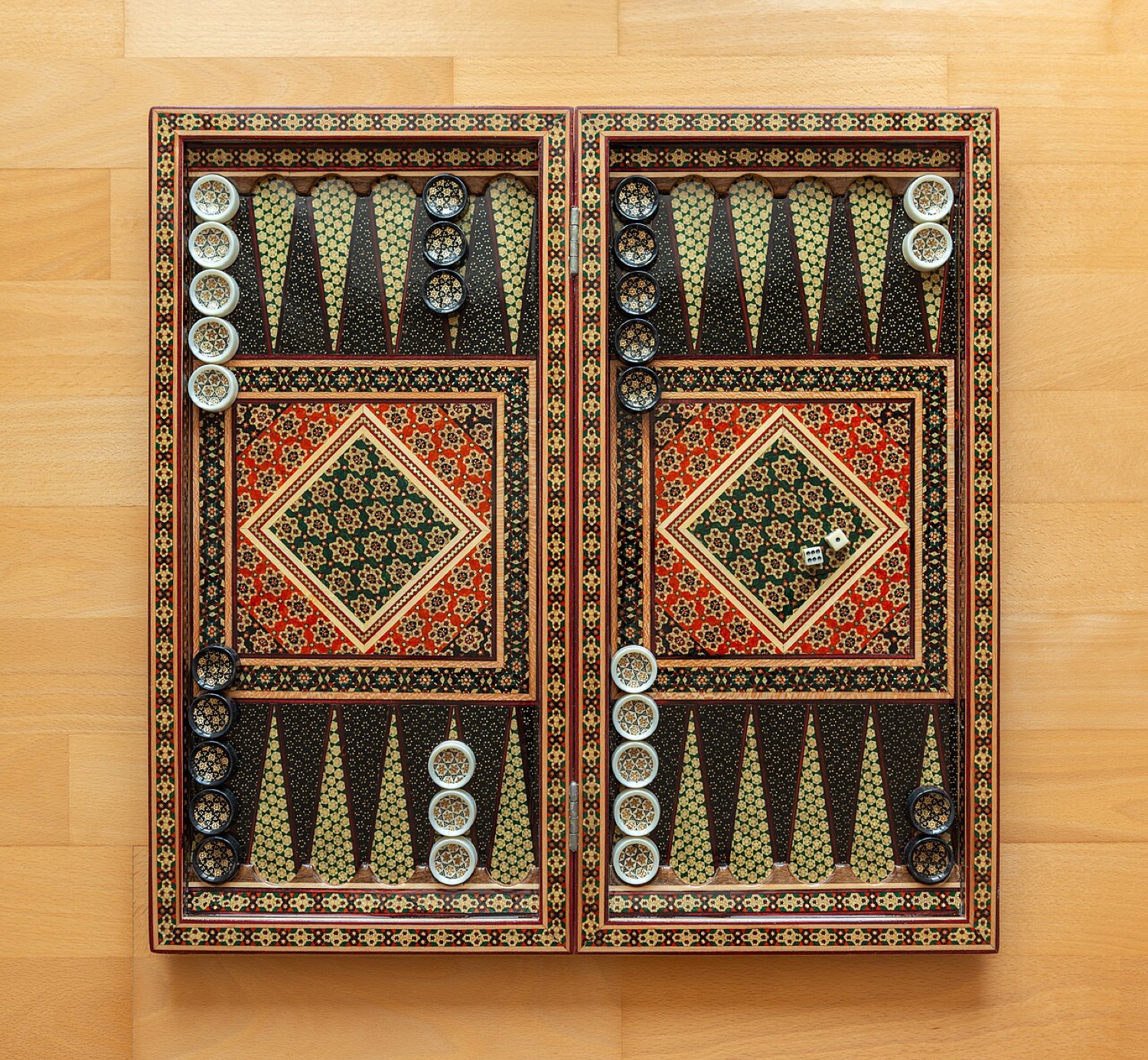
The clatter of dice on a wooden board is the soundtrack of Iraqi cafés. Backgammon, called tawla, has a long history in the region and a culture all of its own.
Walk into a traditional café in Baghdad, Mosul or Erbil and you will probably hear it before you see it: the rattle of two dice, the snap of a checker landing on wood and a shouted number. Backgammon, known in Arabic as tawla, is the café game of the Middle East, played over tea and cigarettes by men of all ages and, increasingly, by women and young people at home and online.
An ancient family
Backgammon belongs to a family of race games played with dice on a board of points. Its early history is debated, but the Persian game of nard was being played in the Sasanian period, and a well-known Middle Persian text tells a story about its invention at the court of the shah. A board found at Shahr-e Sukhteh in eastern Iran, roughly five thousand years old, is sometimes described as an ancestor, though the rules played on it are unknown. The Arabic name tawla comes, via Italian and Turkish, from words for "table", and the Ottoman world spread the game everywhere from the Balkans to Iraq.
The language of the dice
One of the pleasures of tawla is its vocabulary. Across Iraq and the Levant, players call the throws with a mix of Persian and Turkish number words: shesh besh for six-five, hab yak for double one, dubara for double two and dushesh for double six, which is greeted with special enthusiasm. Calling the throw out loud is part of the game's theatre, along with slamming the checkers down a little harder than necessary.
More than one game
A set can be used for several games. Besides the standard race known in the West, Middle Eastern players enjoy variants such as mahbusa, in which a checker can trap an opponent's piece by landing on it, and other regional versions with their own rules. Good players switch between them easily.
Stakes, small and large
In Iraqi cafés the usual stake is social: the loser pays for the tea, or the next round of games. Playing for money is illegal in Iraq and frowned upon by many. Elsewhere, backgammon has a much stronger gambling side. The doubling cube, introduced in New York in the 1920s, turned the game into a contest of nerve as well as luck, because a player can offer to double the stakes at any moment and the opponent must accept or concede. International tournaments, money games in clubs, and online platforms where players bet on matches all grew from that innovation, and backgammon now sits alongside poker as a game where skill and odds matter in equal measure.
Probability at the board
Experienced players think in odds without calling it maths. With two dice there are 36 possible throws, so the chance of rolling any particular double is 1 in 36, and the chance of hitting a single checker six points away, counting combinations, is 17 in 36. Knowing such numbers helps decide when to take a risk and when to play safe. For the deeper roots of dice games in the region, see our article on ancient dice and knucklebones.