The Royal Game of Ur: A 4,500-Year-Old Game of Chance
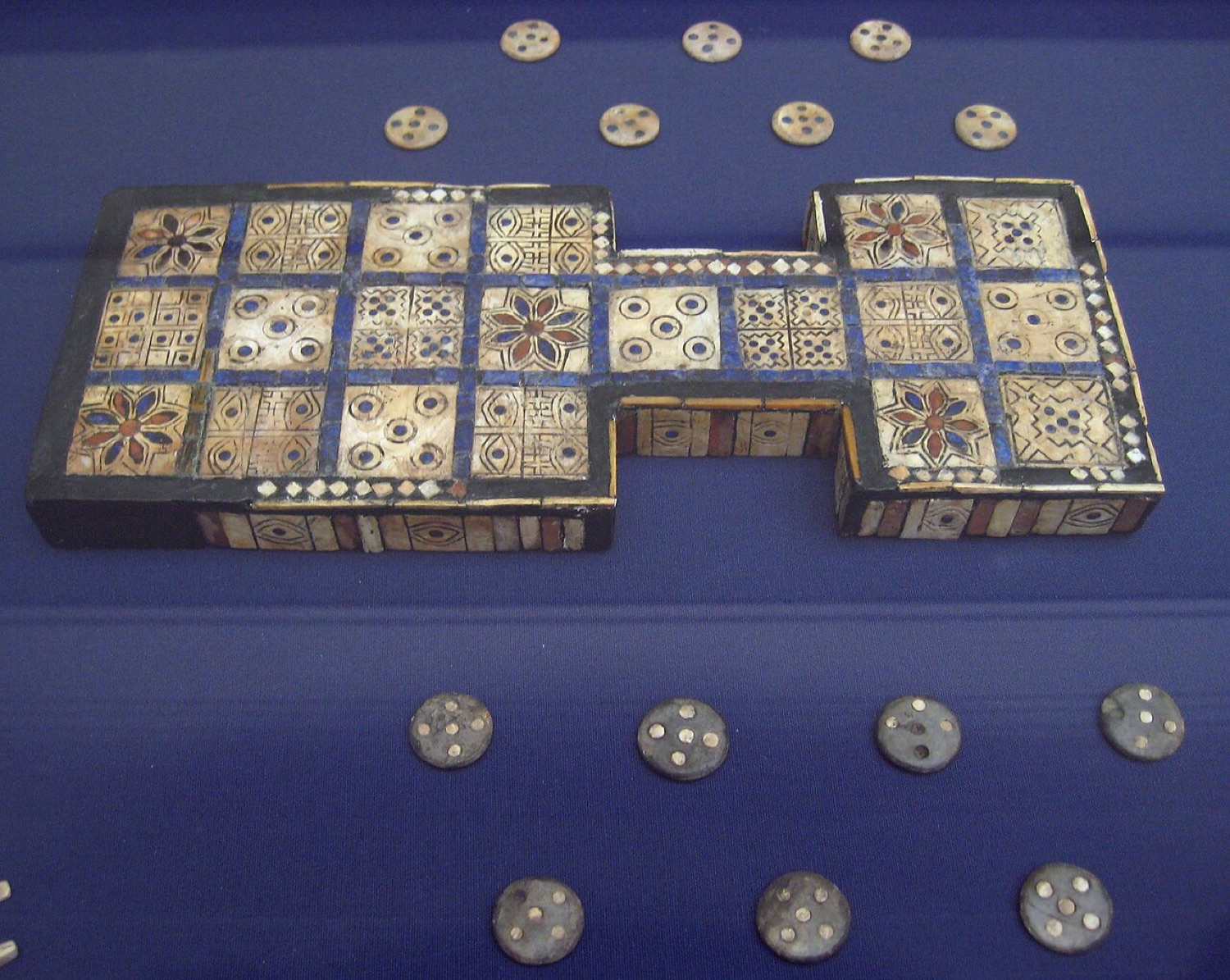
Found in a royal grave in southern Iraq, the Royal Game of Ur is one of the oldest board games known. Its dice, its rules and its links to wagering make it the ancestor of a long line of games of chance.
When Leonard Woolley's team excavated the Royal Cemetery at Ur in the 1920s, they found several game boards among the grave goods. The finest, now in the British Museum, is a hollow wooden box inlaid with shell, red limestone and lapis lazuli, dated to roughly 2600 to 2400 BC. It has twenty squares arranged in an odd shape: a block of twelve, a narrow bridge of two and a block of six. Five squares are marked with rosettes. It is known today as the Royal Game of Ur, and it is one of the oldest board games for which we can reconstruct the rules.
A game for everyone
Despite its royal name, the game was not only for kings. Boards of the same layout have been found across the Near East, from Iran to the eastern Mediterranean and Egypt, and over a period of some three thousand years. Some were simply scratched into stone. One of the best known is incised on the base of a colossal winged bull from the Assyrian palace at Khorsabad, apparently by bored guards. The game seems to have been as common as backgammon is in Middle Eastern cafés today.
How the rules were recovered
The key came from a small clay tablet in the British Museum, written by a Babylonian scribe in 177 BC. Irving Finkel, a curator of cuneiform at the museum, identified it as a description of a game played on the same twenty-square board and used it to reconstruct how the game worked. In his reading, two players race their pieces along a path across the board, and landing on a rosette brings a bonus. The tablet also links certain squares with fortunes, and Finkel's reading suggests that players may have paid or collected tokens as they went, a small wagering element built into the play.
Pyramid dice and the odds
Instead of cubes, the game used tetrahedral dice: little pyramids with two of their four tips marked. Four such dice are thrown together and the number of marked tips facing up gives the move, from zero to four. The odds are not even:
| Throw | Ways (out of 16) | Probability |
|---|---|---|
| 0 | 1 | 6.25% |
| 1 | 4 | 25% |
| 2 | 6 | 37.5% |
| 3 | 4 | 25% |
| 4 | 1 | 6.25% |
A throw of two is the most likely result, just as seven is the most common total with two ordinary dice at a casino craps table. Any skilled player of the game would have learned these odds by experience, choosing which piece to move according to the chances of the next throw. That mix of luck and judgement, with something at stake, is the formula behind most gambling games ever since.
A game that survived
Remarkably, a descendant of the game was still being played in the twentieth century by the Jewish community of Kochi in southern India, whose members described a twenty-square game that Finkel recognised as a version of the ancient one. Today reproductions are sold as souvenirs, and online versions let anyone try the race across the rosettes.
To see where the original came from, read our visit to the Ziggurat of Ur, whose royal tombs held the board.