Mesopotamia: Where the First Cities Began
Long before Baghdad, the plains between the Tigris and the Euphrates produced the first true cities, the first writing and a calendar of ideas we still use.
The Greek name Mesopotamia means "the land between the rivers", and the two rivers in question, the Tigris and the Euphrates, still define Iraq. They rise in the mountains of eastern Turkey, run south through the country and meet near Basra before reaching the Gulf as the Shatt al-Arab. Between them lies a flat, fertile plain that was hard to farm without organised irrigation, and that need for organisation is one reason why people here built some of the world's earliest cities.
Uruk, the first great city
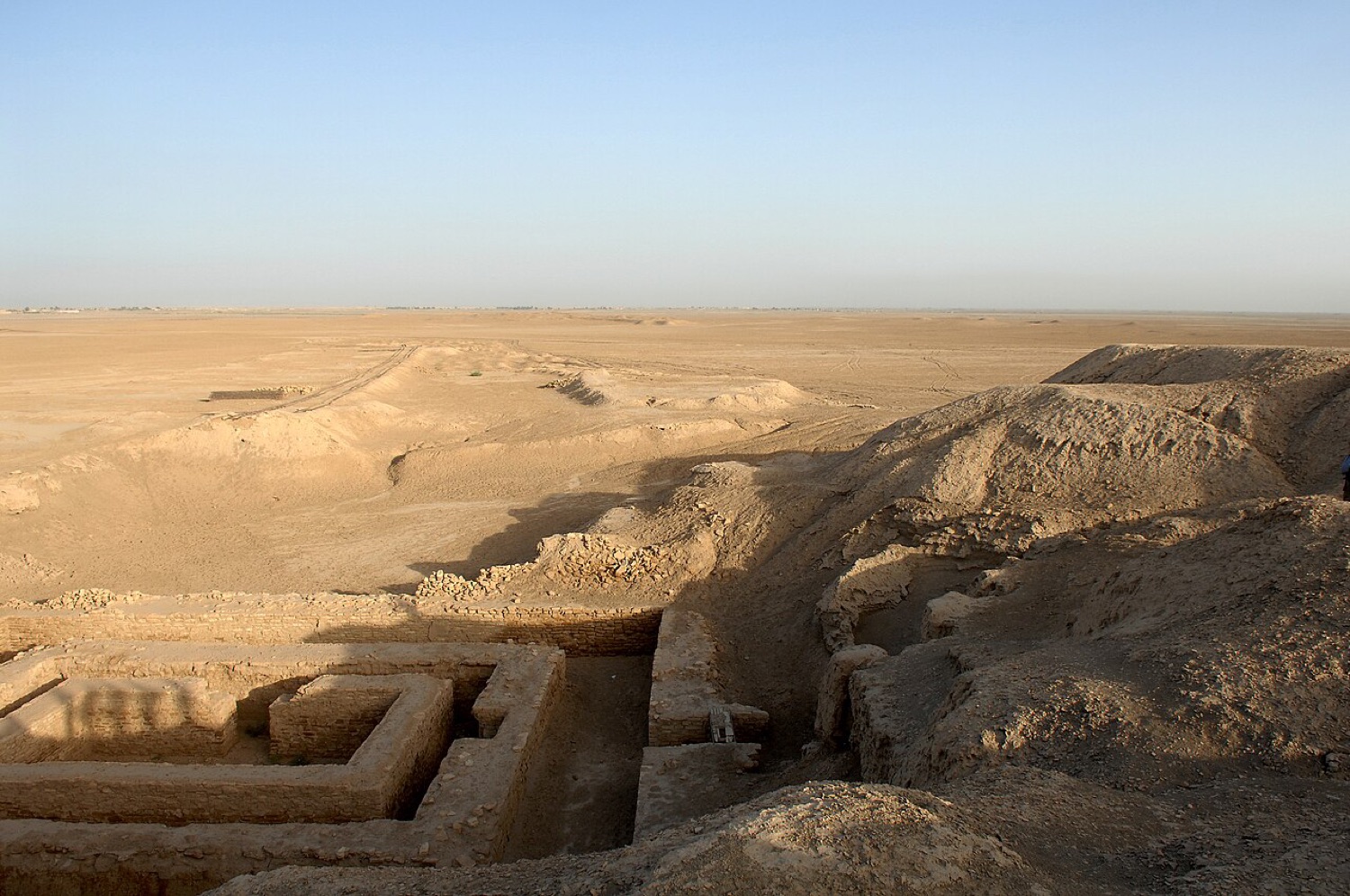
The clearest example is Uruk, known today as Warka, in the south of the country. By the late fourth millennium BC it had grown into a settlement of tens of thousands of people, with monumental temples, workshops, storehouses and a surrounding wall that later legend credited to its most famous king, Gilgamesh. Archaeologists use the name of the city for a whole era, the Uruk period, because so many of the things we associate with urban life appear there first or most clearly.
Among them is writing. The oldest known clay tablets with proto-cuneiform signs come from Uruk and date to roughly 3300 to 3100 BC. They are mostly accounts: rations of barley, numbers of sheep, quantities of beer. Writing began, in other words, as bookkeeping for a city that had become too large to run from memory.
A landscape of city-states
In the third millennium BC southern Mesopotamia was divided among rival Sumerian city-states such as Ur, Lagash, Kish, Nippur and Eridu, each with its own patron god and temple. Around the twenty-fourth century BC Sargon of Akkad united much of the region into what is often called the first empire, and Akkadian, a Semitic language, gradually replaced Sumerian in daily life while Sumerian survived as a language of learning, rather as Latin did in medieval Europe.
Later centuries brought the Old Babylonian kingdom of Hammurabi, the Assyrian empire in the north and the Neo-Babylonian empire of Nebuchadnezzar II. Each left monuments, archives and art that museums around the world still study, and each built on what the first cities of the south had started.
Ideas that outlived the cities
- Counting in sixties. Mesopotamian scribes used a base-60 number system, which is why an hour still has sixty minutes and a circle 360 degrees.
- Law and contracts. Thousands of tablets record loans, sales, marriages and court cases, showing a society that wrote down agreements and expected them to be enforced.
- Literature. The Epic of Gilgamesh, assembled over centuries, is one of the oldest surviving works of literature and still reads as a story about friendship, loss and the limits of human ambition.
- Astronomy. Babylonian observers kept long records of the movements of the moon and planets, and their methods influenced Greek astronomy.
Seeing it today
Uruk, Ur and Eridu are part of a World Heritage listing adopted by UNESCO in 2016 together with the southern marshes, recognising both the ancient cities and the wetland landscape that surrounds them. The sites are open, low and windswept, and much of what was found there now sits in museums in Baghdad, London, Berlin, Paris and Philadelphia. The Iraq Museum in Baghdad, which reopened to the public in 2015 after years of closure, holds the most important national collection.
Visiting a site like Uruk is a lesson in imagination. There is little standing above shoulder height, but the scale of the mounds, the scatter of potsherds underfoot and the knowledge that writing itself was invented a short walk away make it one of the most remarkable places in the Middle East.